


|
ADF-SERIALS RAAF A12 British Aerospace BAC 111 |
||||||||||||||
|
|
||||||||||||||
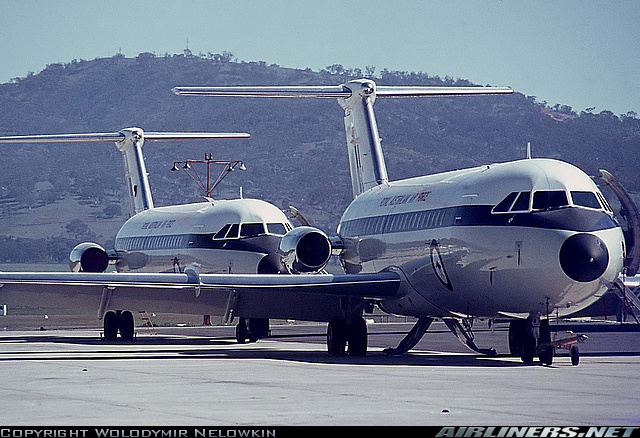
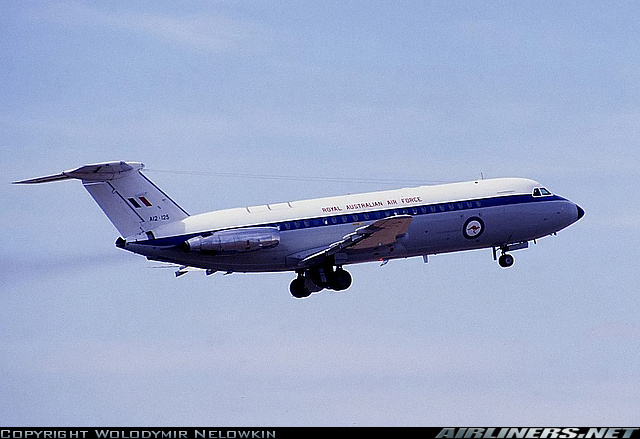
| The two RAAF BAC 111 aircraft were initially fitted with two executive cabins of 26 and 30 passenger seats and were operated in the VIP transport role by 34 Squadron based at Fairbairn, Canberra. Uniquely, these aircraft had a navigator s position in the cockpit and were affectionately known as Trucks in RAAF service. The aircraft were fitted with non-standard Rolls-Royce Spey Mk.511-14s and a beefed up undercarriage with larger low pressure tyres for improved airfield performance and for use to destinations with runways with low bearing strengths. The aircraft were later fitted with a more luxurious 2 X 2 29 seat cabin to the rear while the forward section comprised a galley/bar area forward with a four place table crew area. The main cabin was fitted with four huge pivoting lounge chairs. Between the main lounge and the rear cabin was another four place table with electric typewriter connection on one side of the cabin while on the other side was a three seat divan which folded out into a King Size bed. Apart from operating to most Australian airfields with runways in excess of 6,000 ft length and maintaining regular ministerial shuttles between Canberra, Melbourne and Sydney, the aircraft were flown to destinations throughout the Far East and Pacific and to India, Iran and even a one off trip to Glasgow in the UK in Jun73. The aircraft were also used for special VIP flights such as carrying the Governor General, Shah of Iran, the President of Burma and the UK Royal Family on various occasions. Overseas points visited included Apia (Samoa), Bali (Indonesia), Christmas Island, Cocos Island, Honiara (Solomon Islands), Jakarta (Indonesia), Kuala Lumpur (Malaysia), Manila and Zamboanga (Philippines), Norfolk Island, Noumea (New Caledonia), Nuku Alofa (Tonga), Port Moresby and Rabaul (PNG), Port Vila (Vanuatu), Rarotonga (Cook Islands), Singapore, Suva and Nadi (Fiji) and Tarawa (Kiribati) in the immediate vicinity while further afield points visited included Bangkok (Thailand), Bombay, Calcutta and Delhi (India), Guam, Hong Kong, Kwajelein (Marshall Islands), Okinawa, Tokyo (Japan), Ponape (Micronesia), Pyonyang (N.Korea), Seoul (S.Korea), Beijing, Shanghai and Shenyang (China), Srinigar (Kashmir), Teheran (Iran) while various points in New Zealand were regular training destinations. The fleet was retired in early 1990 having flown over 28,000 hours and carried out over 30,000 landings. Bud Oke has described the ferry flight of A12-124 back to the UK in a fascinating article entitled "The story of the truck - wabbit one" which can be found in the 'Special Features' section on Peter Clark's One-Eleven website bac1-11jet.co.uk. Much of the data on this site has been compiled by myself. (Introduction written by Richard Church, Image by Ron Cuskelly.) |
||||||||||||||
|
||||||||||||||
| It is interesting to note that the two RAAF One-Elevens were the only ones to be delivered new with a navigator's station in the cockpit and had a fitting in the cockpit roof for stellar navigation. They were also were fitted with slightly larger main wheel tyres and operated with them at lower pressures than all other Series 200 aircraft in order that they could operate to airfields with poor surfaces or with low LCNs. | ||||||||||||||

|
The Author of this page is Darren Crick (Updated by Brendan Cowan) Source: Australian Aviation Magazine, RAAF Status Cards, Richard Church, Air Britain. Emails: Sqnldr Brydon Oke, Gordon Birkett, Daniel Leahy, Tjalling Boelman, Richard Church. Converted to CMS 19th August 2025 Updated 7th November 2025 |